Understanding energy, costs, and what works in practice
Clear, straightforward information for property owners and businesses looking at renewable power in the UK.
Clear, straightforward information for property owners and businesses looking at renewable power in the UK.
For many industrial and commercial sites, electricity is no longer a background cost. It has become a central operational concern. Price volatility, network constraints, and pressure to reduce carbon emissions have all pushed solar power higher up the agenda.
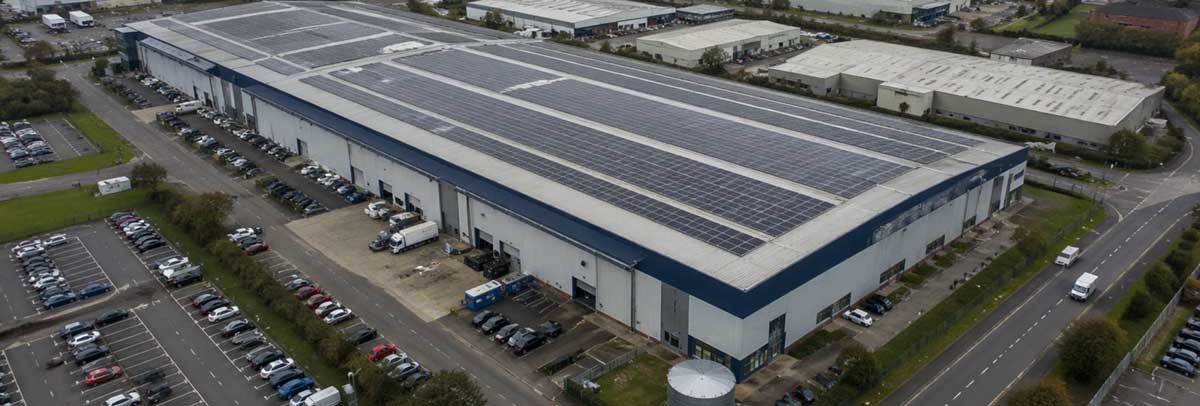
Unlike domestic systems, commercial solar is rarely about a simple installation. It tends to form part of a wider energy strategy. The aim is usually to reduce daytime import, improve cost predictability, and make better use of available roof or land space.
In practical terms, solar works best where there is a consistent daytime load. Warehouses, factories, offices, and retail sites often fit this pattern, although the detail varies significantly between sites.
A typical system consists of photovoltaic (PV) panels, mounting systems, inverters, cabling, and connection equipment. The panels generate direct current (DC), which is converted into alternating current (AC) by inverters for use within the building.
Most installations connect behind the meter. This means the generated electricity is used on site first, reducing imported energy. Any excess may be exported, depending on the commercial arrangement and grid connection permissions.
System sizes vary widely. Smaller commercial systems may be 20–50 kWp, while large industrial installations can exceed several hundred kilowatts. The physical size is often dictated by available roof space, structural limits, and connection capacity rather than demand alone.
One of the key technical considerations is how well solar generation aligns with site demand. Solar output peaks around midday and drops off in the early morning, evening, and winter months. This pattern does not always match operational usage.
Sites with steady daytime processes tend to benefit most. For example, manufacturing lines, refrigeration, or office operations can absorb a high proportion of generated energy. This improves financial performance by reducing reliance on export.
Where demand is lower during peak generation periods, surplus energy may be exported or curtailed. In some cases, this leads to the consideration of battery storage or load shifting to improve utilisation.
Not every roof is immediately suitable for solar panels. Structural capacity is a primary concern. While panels themselves are not excessively heavy, the combined effect of mounting systems, wind uplift, and load distribution must be assessed.
Roof type also matters. Metal sheet roofs are often straightforward to work with, while older felt or fragile surfaces may require additional care or reinforcement. Access for installation and maintenance is another practical factor that can influence design.
Ground-mounted systems are sometimes used where roof space is limited or unsuitable. These require available land and may involve additional planning and security considerations.
Integrating solar into an existing electrical system is not always straightforward. The site’s incoming supply capacity can limit how much generation can be connected. In some cases, export restrictions are imposed by the network operator.
Where sites are already close to their supply limit, solar may still be viable, but careful design is needed. This can include export limitation devices or coordination with other equipment such as batteries or generators.
Protection systems, switchgear compatibility, and cable capacity must all be reviewed. On larger sites, the solar installation becomes part of a more complex electrical infrastructure rather than a standalone addition.
The cost of commercial solar systems has reduced over time, but installation remains a significant capital investment. The financial case usually depends on how much of the generated electricity can be used on site.
Systems that achieve high self-consumption tend to deliver better returns. Savings come from avoided electricity purchases rather than export income. Maintenance costs are generally low, although inverters may require replacement over time.
Performance is affected by factors such as orientation, shading, and system design. In the UK climate, output varies seasonally, with much lower generation during winter months. This variability needs to be understood when estimating savings.
Over the longer term, solar can provide a degree of protection against rising energy costs. It does not eliminate reliance on the grid, but it can reduce exposure during daylight hours.
On its own, solar rarely solves all energy challenges for industrial or commercial sites. It is best viewed as one part of a broader approach. This may include demand management, battery storage, or changes to operational patterns.
For sites facing supply constraints, solar can help reduce peak demand during certain periods. However, it does not provide consistent output and cannot be relied upon for critical loads without additional support.
The most effective installations are those that are properly matched to the site’s characteristics. This includes load profile, building structure, and future plans. A well-considered system can deliver steady, predictable benefits over many years, but it depends heavily on getting the fundamentals right at the start.